Dane DeSutter, Ph.D.

Research

Embodiment, cognition, and the things we build.

Statement

I study how people use their bodies to think, communicate, and interact with the world around them. Gestures are my primary lens: they reveal how people reason, how they convey meaning to one another, and how they interact with their social and material world.

I pursue this knowledge for what it lets us build. Understanding people across these three registers points to concrete ways to design better products and environments, a commitment I have carried through learning sciences research and through product and user research in industry.

Today that work extends to artificial intelligence and robotics. As we build systems that see, respond to, and work alongside people, understanding the human body becomes essential to designing technology that strengthens what people can do.
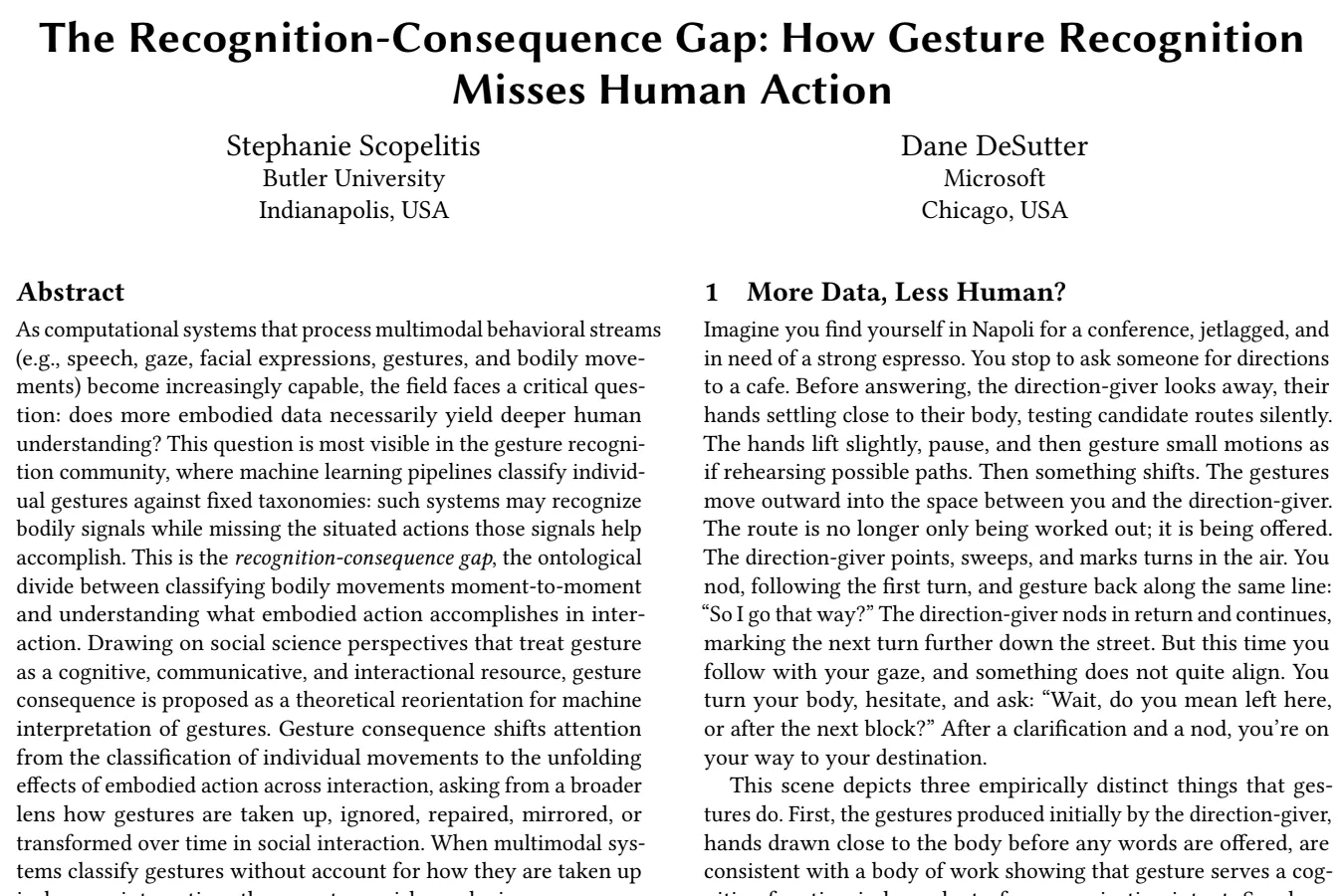
The first page of the paper The Recognition-Consequence Gap: How Gesture Recognition Misses Human Action, by Stephanie Scopelitis and Dane DeSutter, showing the title, the two authors and the beginning of the abstract.
ICMI 2026Blue Sky Best Paper Award

The Recognition-Consequence Gap

Scopelitis & DeSutter · Proceedings of ICMI 2026

Multimodal systems usually label gestures as isolated acts, but a gesture's meaning shows up in what it does between people. We argue that annotation should follow action and consequence across an interaction, which reframes a core training-data problem for multimodal AI.

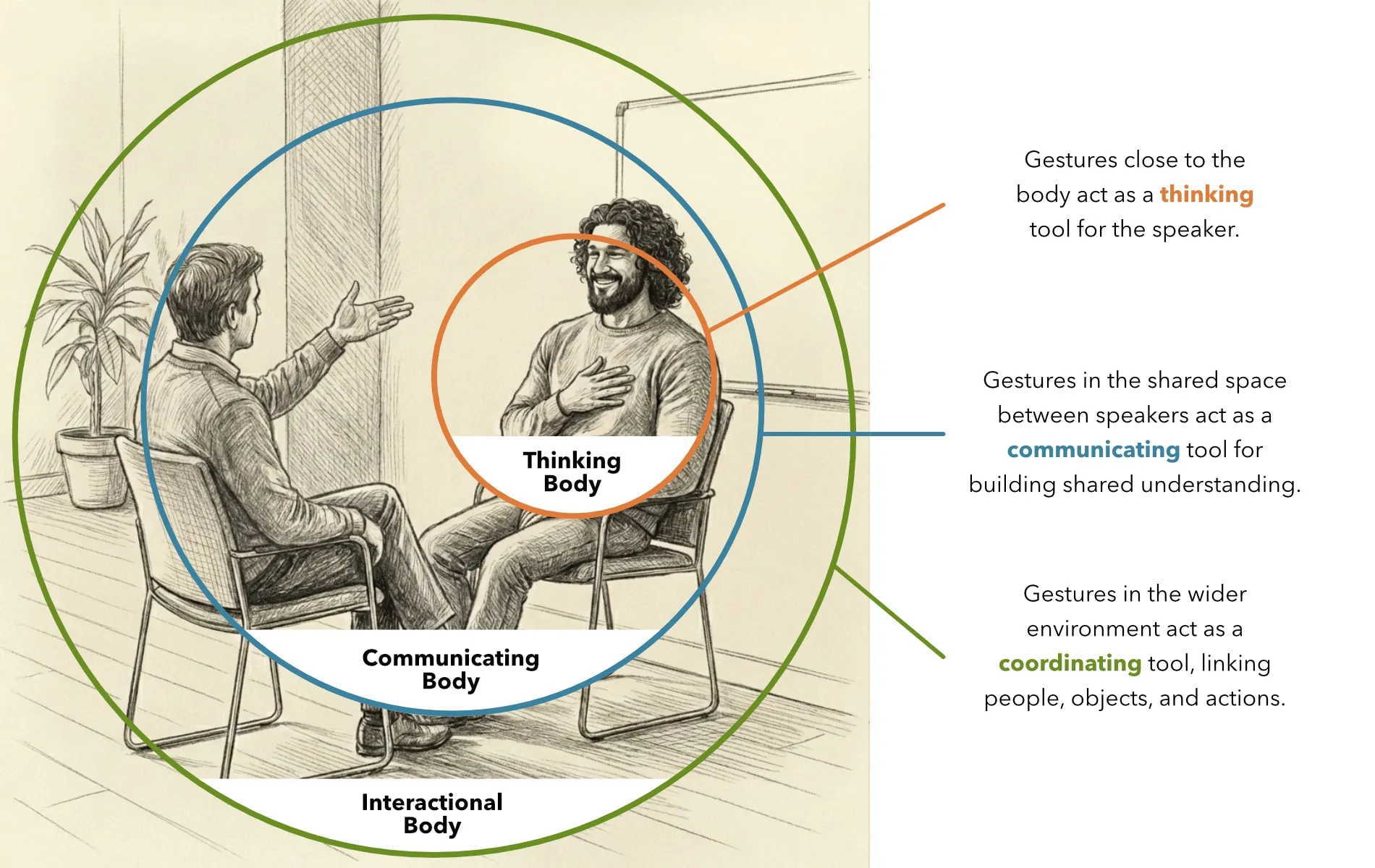
Diagram of the Three Bodies Framework. A pencil sketch of two people talking in chairs sits inside three nested circles labelled Thinking Body, Communicating Body and Interactional Body. Callouts say that gestures close to the body are a thinking tool for the speaker, gestures in the shared space between speakers are a communicating tool for building shared understanding, and gestures in the wider environment are a coordinating tool linking people, objects and actions.
NordiCHI 2026 · Tutorial

The Three Bodies Framework

DeSutter & Scopelitis · NordiCHI 2026 Adjunct Proceedings

Developed with Stephanie Scopelitis, the Three Bodies Framework brings together separate traditions in gesture research into a single nested model: the thinking body, the communicating body and the interactional body. It offers a practical method both for analyzing gestures and for using them deliberately, in research, teaching and everyday collaboration.

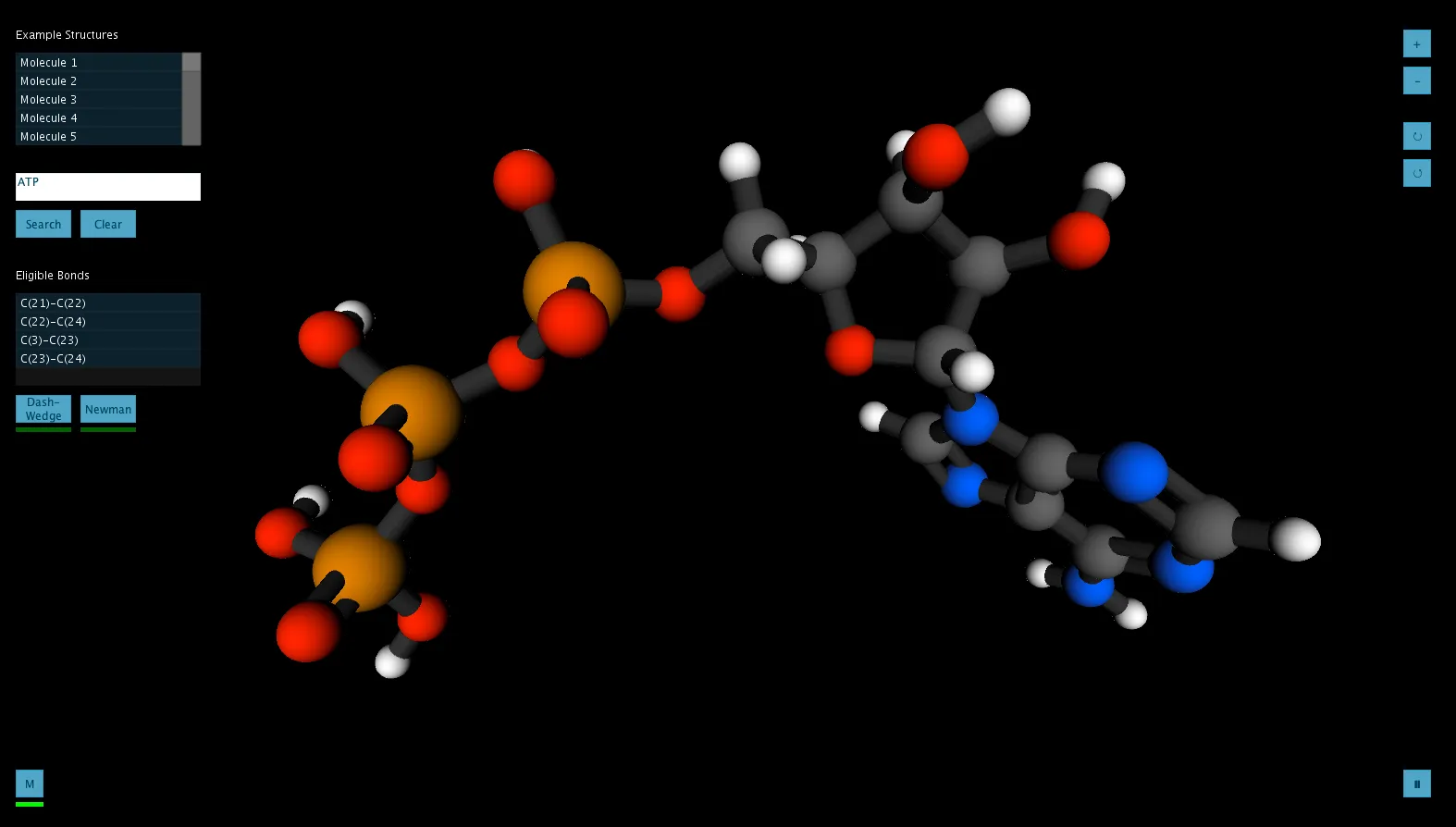
Screenshot of the molecular visualizer from the dissertation: a ball-and-stick model of an ATP molecule on a black background, with a panel of example structures and eligible bonds on the left and zoom and rotate buttons on the right.
Doctoral research · UIC, 2019

Embodied learning and spatial thinking

Advisor: Mike Stieff

My doctoral research tested whether gestures and gesture-driven interfaces help students learn the spatial concepts behind organic chemistry. Across experiments with 160 students, standard content assessments showed no clear advantage for embodied instruction. Close analysis of students' speech and gestures, however, revealed a subtler shift: they made more predictions, imagining molecules in motion, and described themselves as the agents carrying out those transformations.

Research interests

Gesture and embodied cognition; multimodal interaction; perception of human movement and nonverbal behavior in interactive and robotic systems; human-AI interaction and trust; evaluation of AI system output.

Education

2019

Ph.D., Learning Sciences

University of Illinois Chicago. Thesis: Spatial Thinking in STEM: Embodied Learning Environments and Student Understanding of Spatial Concepts. Advisor: Mike Stieff.

2009

B.S., Applied Physics

Purdue University. Minors in Chemistry and in German Language and Literature.

Appointments

2025–

Senior Product Researcher

Microsoft, Power BI and Fabric

Mixed-methods research on human-AI interaction in AI-assisted data analytics (Copilot), with practitioners in Europe, North America and Oceania.

2020–2024

Product Manager, AI and Analytics

Catalyst Education · earlier User Researcher, Data Scientist and Software Engineer

Experiments on LLM reliability for coding unstructured text, learning analytics on cross-institutional course data, and survey research on AI-supported grading.

2019–2020

Postdoctoral Researcher

Learning Sciences Research Institute, University of Illinois Chicago

Design-based research on the Connected Chemistry Curriculum; more than 100 browser-based simulations used in schools in over 20 countries.

2012–2019

Graduate Research Assistant

Learning Sciences Research Institute, University of Illinois Chicago

Gesture as evidence of spatial reasoning in STEM, across four grant-funded projects and more than 450 interviews.

2016–2017

Data and Software Engineer

Argonne National Laboratory

Graph data model and geospatial visualization of interdependencies in critical infrastructure.

Publications

Book

  1. 2026

    DeSutter, D., & Scopelitis, S. A. Body Talk: Using Gestures to Rethink Human-Centered Products. Rosenfeld Media.

    Link ↗

Peer-reviewed conference proceedings

  1. 2026

    Scopelitis, S. A., & DeSutter, D. The recognition-consequence gap: How gesture recognition misses human action. Proceedings of ICMI 2026, ACM.

    Blue Sky Best Paper AwardDOI ↗

  2. 2026

    DeSutter, D., & Scopelitis, S. A. The Three Bodies Framework: A hands-on method for gesture analysis in HCI. NordiCHI 2026 Adjunct Proceedings, ACM.

    TutorialDOI ↗

  3. 2020

    DeSutter, D., & Stieff, M. Designing for spatial thinking in STEM: Embodying perspective shifts does not lead to improvements in the imagined operations. ICLS 2020.

    Link ↗

  4. 2016

    DeSutter, D., & Stieff, M. Embodied actions to support spatial thinking in STEM: Structural diagrams in organic chemistry. ICLS 2016, Vol. 2.

  5. 2016

    Ainsworth, S., Stieff, M., DeSutter, D., et al. Exploring the value of drawing in learning and assessment. ICLS 2016, Vol. 2.

  6. 2014

    Stieff, M., Lira, M., & DeSutter, D. Representational competence & spatial thinking in STEM. ICLS 2014.

  7. 2014

    DeSutter, D., & Stieff, M. Taking a new perspective on spatial representations in STEM. ICLS 2014.

Journal articles

  1. 2021

    Stieff, M., & DeSutter, D. Sketching, not representational competence, predicts improved science learning. Journal of Research in Science Teaching, 58(1).

    DOI ↗

  2. 2020

    Stieff, M., Werner, S., DeSutter, D., Franconeri, S., & Hegarty, M. Visual chunking as a strategy for spatial thinking in STEM. Cognitive Research: Principles and Implications, 5(1).

    DOI ↗

  3. 2018

    Stieff, M., Origenes, A., DeSutter, D., et al. Operational constraints on the mental rotation of STEM representations. Journal of Educational Psychology, 110(8).

    DOI ↗

  4. 2017

    DeSutter, D., & Stieff, M. Teaching students to think spatially through embodied actions: Design principles for learning environments in science, technology, engineering, and mathematics. Cognitive Research: Principles and Implications, 2(1).

    DOI ↗

  5. 2017

    Cooper, M. M., Stieff, M., & DeSutter, D. Sketching the invisible to predict the visible: From drawing to modeling in chemistry. Topics in Cognitive Science, 9(4).

    DOI ↗

  6. 2016

    Stieff, M., Scopelitis, S., Lira, M. E., & DeSutter, D. Improving representational competence with concrete models. Science Education, 100(2).

    DOI ↗

Book chapter

  1. 2019

    Winter, J. E., Wegwerth, S. E., DeKorver, B. K., Morsch, L. A., DeSutter, D., et al. The Mechanisms App and platform: A new game-based product for learning curved arrow notation. In Active Learning in Organic Chemistry (ACS Symposium Series, Vol. 1336).

    DOI ↗

Conference presentations

Abstract-reviewed contributions. Papers published in full appear under Publications.

  1. 2026

    Scopelitis, S. A., & DeSutter, D. The recognition-consequence gap: How gesture recognition misses human action. ICMI 2026, Naples, Italy. Talk

  2. 2024

    DeSutter, D. Towards metrics to assess A.I.-driven rubric grading in chemistry labs. BCCE 2024, Lewiston, ME. Talk

  3. 2024

    Dark, M., & DeSutter, D. Improving the grading experience: An analysis of the factors that impact the quality of rubrics in chemistry laboratory courses. BCCE 2024, Lewiston, ME. Talk

  4. 2024

    DeSutter, D. Time on task: Using distributed user events to estimate active grading time and time spent learning. ACS Spring 2024, New Orleans, LA. Talk

  5. 2022

    DeSutter, D. Labflow: Using big data to trace and assess laboratory skills. BCCE 2022, West Lafayette, IN. Talk

  6. 2022

    DeSutter, D., & Crowe, E. Labflow & Data Insights: Using real time grading data to identify TAs in need of coaching early in the semester. BCCE 2022, West Lafayette, IN. Talk

  7. 2022

    DeSutter, D., & Zumalt, C. Using Labflow as a platform to accelerate research in laboratory education. ACS Spring 2022, San Diego, CA. Talk

  8. 2021

    DeSutter, D. Automating the detection of grading disparities between teaching assistants in general chemistry laboratory activities. ACS Spring 2021, online. Poster

  9. 2018

    Jardine, N., Franconeri, S., Szuba, A., DeSutter, D., et al. Re-evaluating the cognitive capacities and processes underlying visuospatial thinking in chemistry. CIRCLE Conference, St. Louis, MO. Poster

  10. 2018

    Stieff, M., Hegarty, M., Franconeri, S., Werner, S., DeSutter, D., et al. Mechanisms of visuospatial thinking in STEM. Spatial Cognition 2018, Tübingen, Germany. Poster

  11. 2017

    Stieff, M., & DeSutter, D. Supporting learning about molecular structure through embodied actions. ESCoP 2017, Potsdam, Germany. Talk

  12. 2016

    DeSutter, D., & Stieff, M. Embodied actions to support spatial thinking in STEM: Structural diagrams in organic chemistry. ICLS 2016, Singapore. Poster

  13. 2016

    Stieff, M., & DeSutter, D. Drawing from dynamic visualizations. ICLS 2016, Singapore. Talk

  14. 2014

    Stieff, M., Lira, M., & DeSutter, D. Representational competence & spatial thinking in STEM. ICLS 2014, Boulder, CO. Talk

  15. 2014

    DeSutter, D., & Stieff, M. Taking a new perspective on spatial representations in STEM. ICLS 2014, Boulder, CO. Poster

  16. 2014

    Stieff, M., DeSutter, D., & Lira, M. The Connected Chemistry Curriculum. AERA Annual Meeting 2014, Philadelphia, PA. Talk

  17. 2013

    DeSutter, D., & Stieff, M. Using head tracking to address representational competence in organic chemistry. Gordon Research Conference on Visualization in Science and Education, Smithfield, RI. Poster

Practitioner and industry talks

  1. 2024

    Lab grading: Streamline grader workflows with AI assistance. Webinar hosted by Catalyst Education, online.

  2. 2024

    The stochastic parrot’s song: Examining the reliability of LLMs to tag unstructured data and the metrics we might consider to evaluate it. Quant UX Con 2024, online.

  3. 2024

    Keeping the body in mind: What gestures and embodied actions tell you that users may not. Advancing Research 2024, Rosenfeld Media, online.

  4. 2024

    Time on task: How user data can be used to estimate the time TAs spend grading and students engage in lab learning activities. Webinar hosted by Catalyst Education, online.

  5. 2023

    Data Insights: Using data to manage your course. Webinar hosted by Catalyst Education, online.

Industry research

Author or co-author of ten internal research reports at Microsoft on human-AI interaction and enterprise AI adoption.

Awards and grants

2026

Blue Sky Best Paper Award, third place, ACM International Conference on Multimodal Interaction (ICMI 2026), with S. A. Scopelitis.

2018–2019

National Science Foundation INTERN supplement, industry research placement at Alchemie, Inc. and Intelligent Automation, Inc.

Service and mentoring

2025–

Co-organizer, AI workflow exchange series for research and program teams, Microsoft

2024

Volunteer researcher and research team mentor, Out in Tech

2012–2020

Supervision of a student software developer and training of junior research staff, University of Illinois Chicago

Languages and memberships

English (native) · German (proficient)

Association for Computing Machinery (ACM)

ORCID 0000-0002-4340-9514