Podcast · November 2026
A conversation with Toby Miller, on a cultural studies podcast
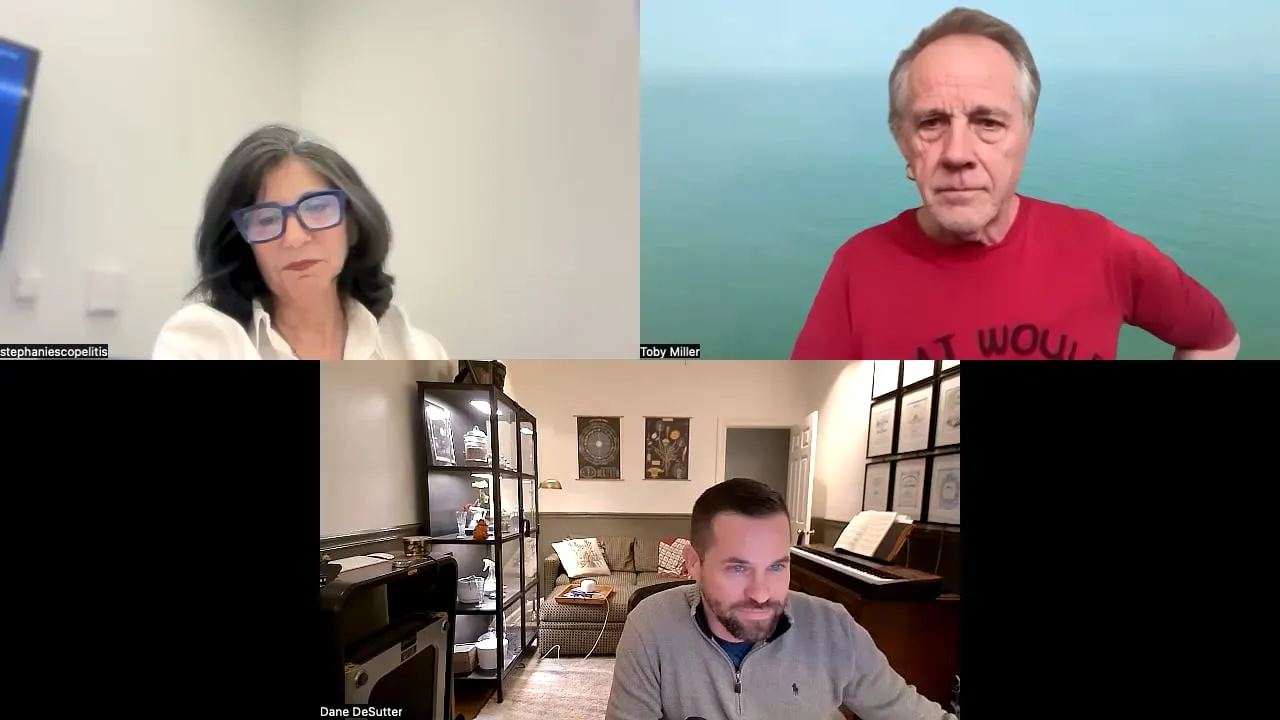
Stephanie Scopelitis and I joined Toby Miller for a recorded conversation on a cultural studies podcast. It opens on Vimeo.
Watch on Vimeo ↗Speaking
I speak to product and user research teams about what gestures reveal that people don't say, and to learning scientists about how the body supports thinking. Here are the talks I can share, with a recording wherever one exists.
Podcast · November 2026
Stephanie Scopelitis and I joined Toby Miller for a recorded conversation on a cultural studies podcast. It opens on Vimeo.
Watch on Vimeo ↗ Recording on the Rosenverse
Advancing Research 2024 · Rosenfeld Media · March 26, 2024
My conference talk for product and user researchers on what gestures and embodied actions can tell you that participants never say aloud. The recording is on the Rosenverse, for people who already have access.
Open on the Rosenverse ↗QuantQual Bridge · Rosenfeld Media · June 2023
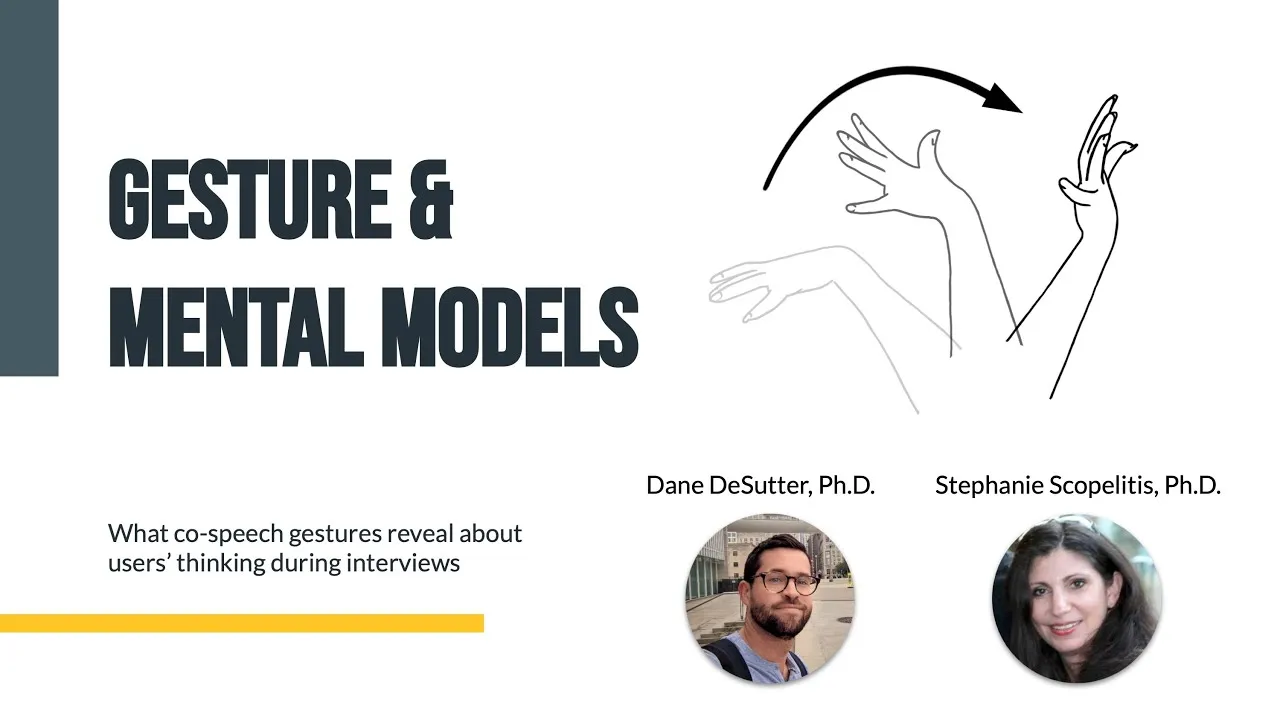
How product and user researchers can enrich a one-on-one interview by attending to the gestures people make while they talk. We cover gesture theory, how to use gesture to ask deeper questions, how to analyze interview video, and where open source tools like MediaPipe can help.
Lecture · University of Illinois Chicago · 2018
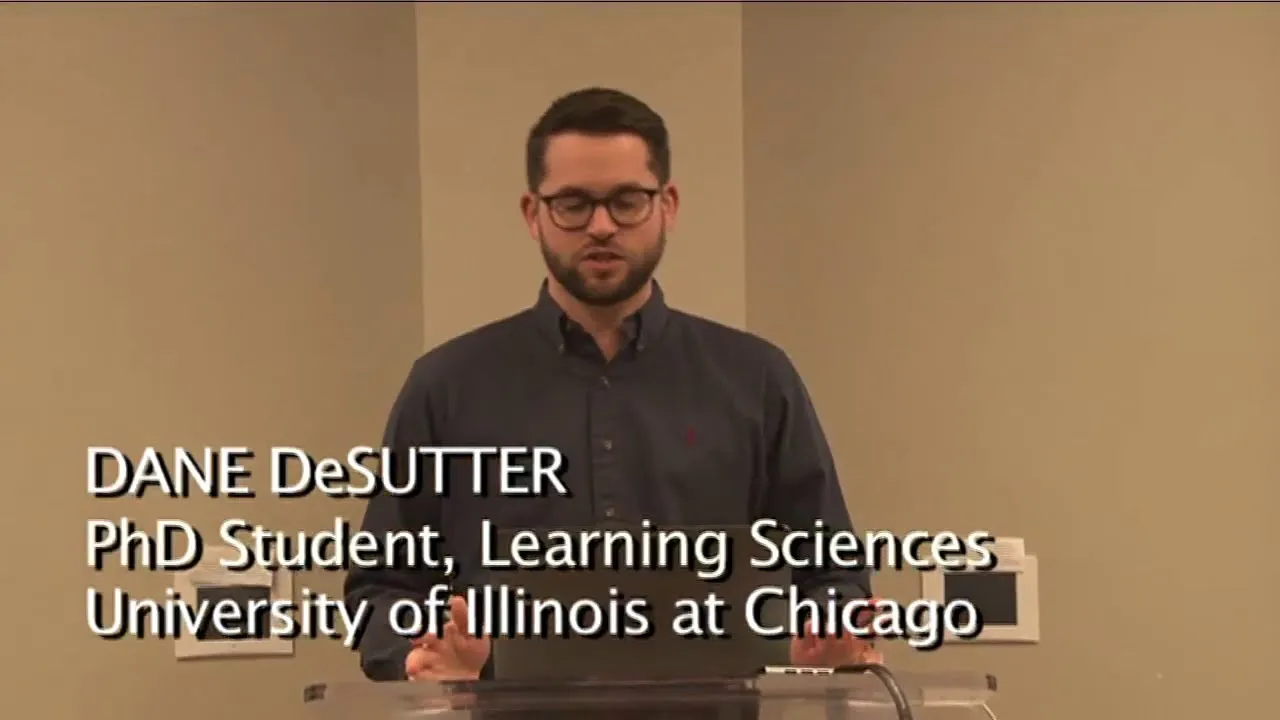
A look at learning environments built to teach spatial concepts in undergraduate organic chemistry, the evidence that spatial thinking is central to science, and what it would take for instruction that uses embodied actions to work in real classrooms.
Conference papers and posters are listed with the rest of my work on Research.
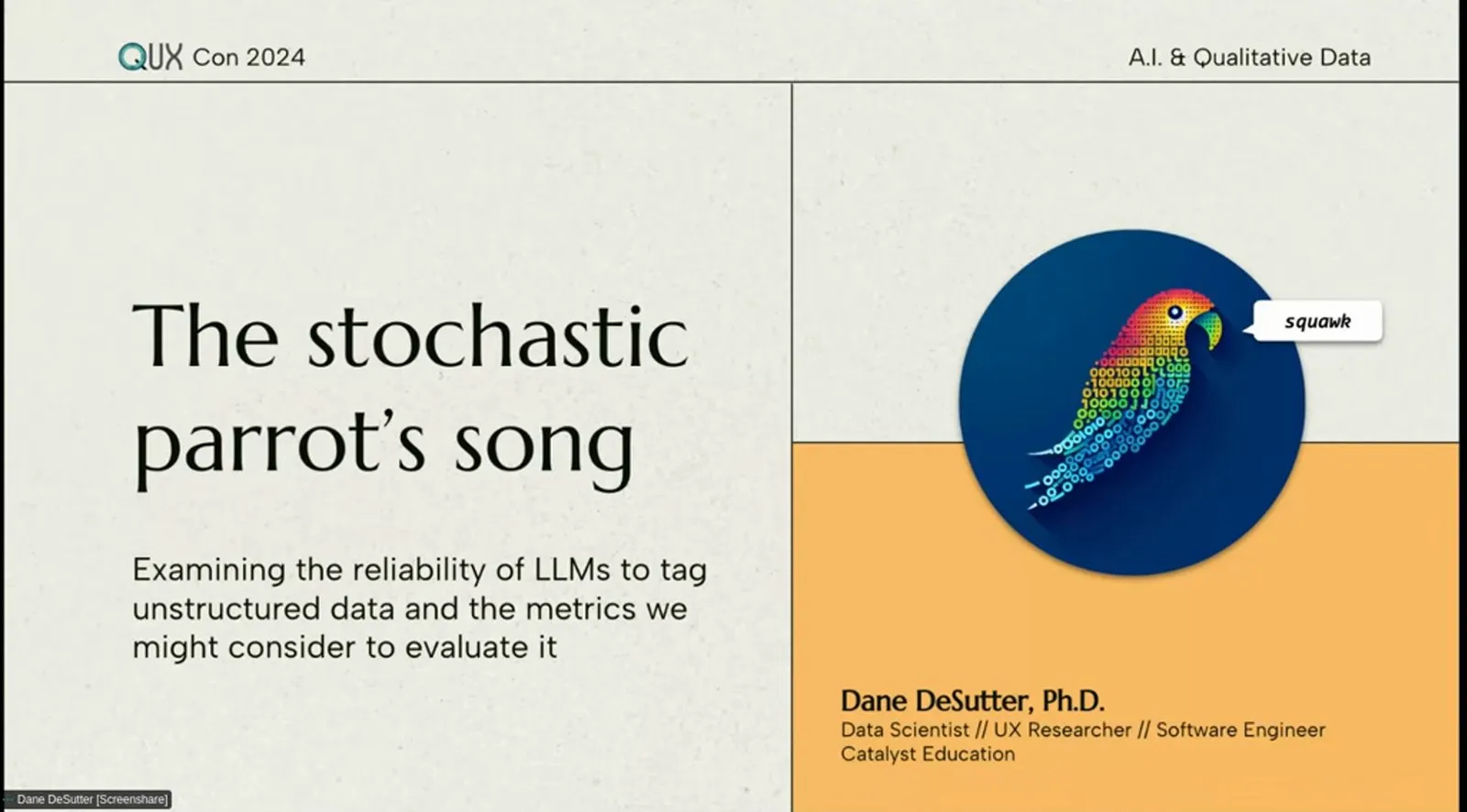
Quant UX Con 2024 · June 12, 2024
Researchers are turning to AI tools and off-the-shelf LLMs to analyze unstructured data like interview transcripts, but there is little discussion of how reliably those tools reproduce their own analysis. I argue that the non-deterministic nature of AI is at odds with inductive and deductive inference, and walk through hyperparameters like temperature and metrics such as consistency, text similarity and inter-rater reliability for judging whether a prompt is reliable enough to trust.
Panel
Beyond the Console: The rise of the gamer experience
Open on the Rosenverse ↗Talks from my work at Catalyst Education on Labflow: what its data can show about lab skills and grading, and how teaching teams can use it.
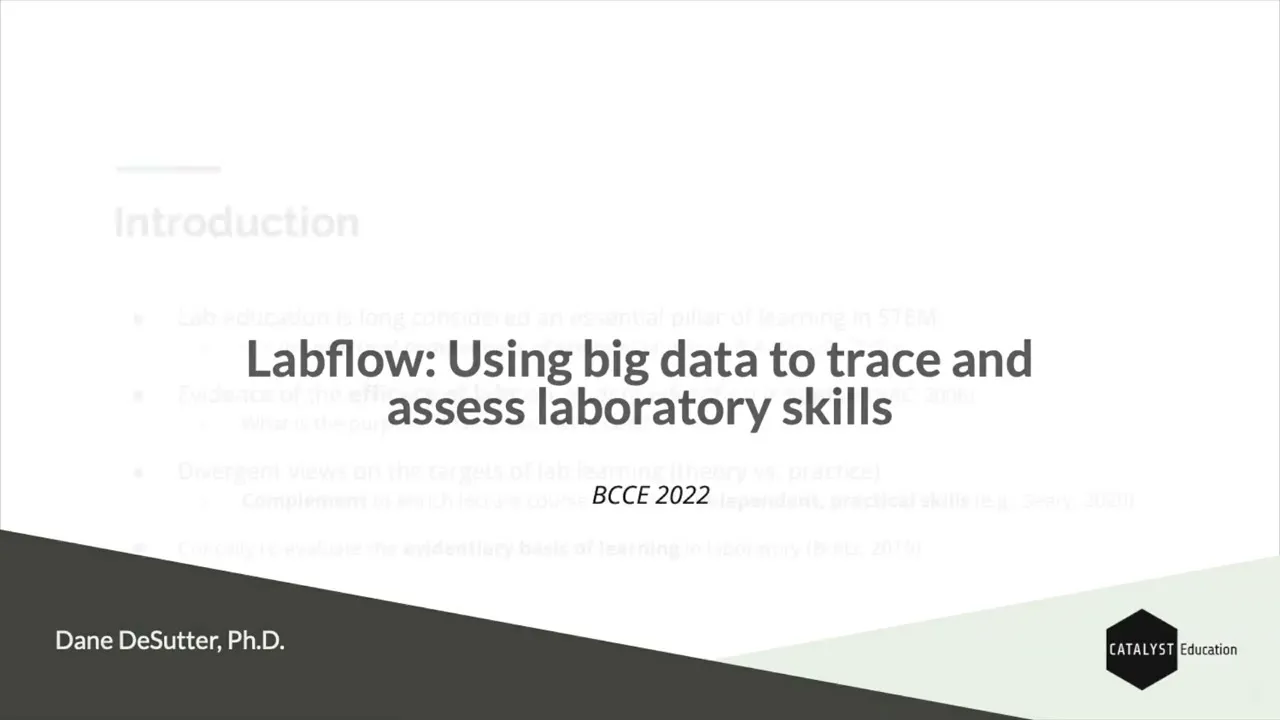
Biennial Conference on Chemical Education · 2022
Lab skills are usually judged by an instructor or teaching assistant, which makes the assessment subjective. This talk explores how to quantify those skills and introduces what the data Labflow collects can show.
ACS Spring 2021 · Poster
Teaching assistants often grade the same lab work with different levels of stringency. I describe a learning analytics dashboard in Labflow that detects and visualizes those disparities, and the models, including Rasch measurement, that can estimate how strict each grader is.
2024
Lab grading: Streamline grader workflows with AI assistance.
2024
Time on task: How user data can be used to estimate the time TAs spend grading and students engage in lab learning activities.
2023
Data Insights: Using data to manage your course.
Organizing a conference, a team learning day or a class? I'd be glad to hear about it.
Write to me